What is an SPV and why do investors use them?

Why do investors use SPVs?
SPVs are used by venture capitalists to consolidate a pool of capital to invest in a startup. For individual investors, it allows them to invest in individual companies in smaller amounts – overcoming barriers to entry on investment.
What is an SPV limited company?
SPVs are a legal entity created to allow investors to pool their money together to invest in a single company.
How do SPVs work?
SPVs are formed as limited liability companies (LLCs) or limited partnerships. Both types of SPV are owned by their members and any income or losses are divided amongst the members of the SPV – they’re a pass through security. Members can own different amounts of an SPV, so any returns or losses are divided up accordingly.
When an LP invests in an SPV they become a “member” of the SPV. The LP invests capital in the SPV, for which they get a percentage of membership interest. An example to illustrate how that would work would be:
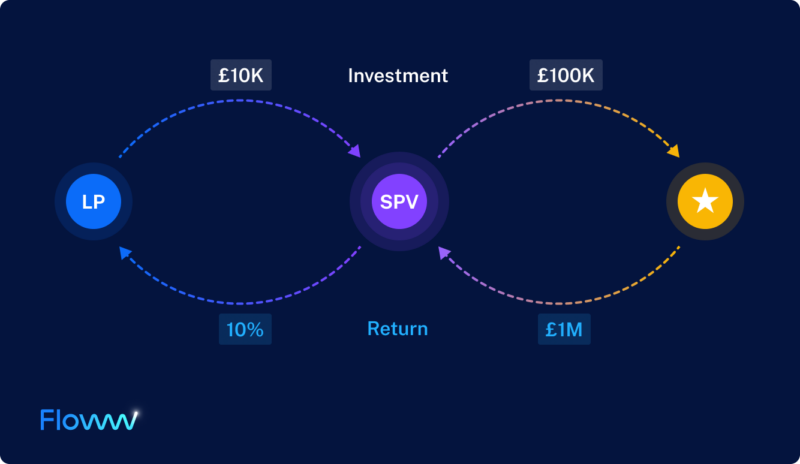
Once an SPV has finished raising capital, it makes a single investment in a start-up, sending a single fund transfer to the company they’re investing in. The SPV will be a single investing entity on the company’s cap table.
The LP is an investor in the SPV, and the SPV is an investor in the company.
There may be limits to how much any individual investor can put into an SPV. This is dictated by how much capital the SPV raises. For SPVs raising £10M or less, the SEC permits a maximum of 250 accredited investors. For SPVs raising over £10M, the limit is 100 investors.
What’s the difference between an SPV and a fund?
In a nutshell, a fund invests into multiple companies, and an SPV invests into a single company.

GPs raise venture capital funds to invest in start-ups over several years. By investing into these managed funds, investors, LPs, get exposure to a curated selection of different companies. This selection of companies make up the portfolio of the fund.
What is the benefit of investing in an SPV as an investor?
SPVs become beneficial to investors when an LP wants to invest in one specific company, or a GP comes across a promising investment while they don’t have a fund at their disposal.
As with traditional venture funds, SPVs charge management fees and carried interest. SPVs however, call all capital upfront instead of on different occasions throughout the lifecycle of the fund.
For people starting out in investing, SPVs can be a great way to build a track record.
How do SPVs benefit LPs?
Greater access to investment. SPVs allow individuals to pool their capital and invest smaller amounts. Direct investments typically have higher minimum investment amounts.
Better options. LPs often choose funds based on the GP managing it and the investment thesis governing the fund, but don’t have any say on what investments are made by the GP. SPVs let every individual know what each investment is – which means no LP has to be a part of an investment they aren’t interested in.
How do SPVs benefit GPs?
Ability to double-down on investments. SPVs can be used by GPs to invest more follow-on to earlier investments they’ve made, even if their fund doesn’t have enough capital left.
How do SPVs benefit founders and companies?
Less admin. SPVs pool capital from groups of investors, so founders don’t have to add each amount individually to their cap table, making it easier to manage.
How do investors set up SPVs?

What are the risks of an SPV?
- No diversification. Because SPVs invest into a single company, if it fails, investors may see no return on their capital.
- Investors have no voting rights. LPs who invested as a part of an SPV have no voting or information rights because the official shareholder on the company’s cap table is the SPV. Direct shareholders do benefit from those rights, but LPs investing in an SPV must trust that their GP has their best interests at heart.
- Preferential treatment. Although SPVs open up deal flow to LPs, GPs can choose what deal flow they share. GPs may only open particular SPVs to specific groups of LPs they favour or know and trust.
- Carry and management fees. LPs investing in an SPV may be charged carry and management fees, which are usually viewed as the cost of being able to access great deals.
There are a few downfalls which could rule out the use of SPVs for many investors which are important to consider. Traditional SPVs have a number of short comings which include:
- No EIS or SEIS support
- No data rights or warranties
- No possibility of global ownership
- No redemption to the underlying